Malian photographer ushered in a 'visual revolution'

The late Malian photographer Seydou Keïta has been likened to a griot — a storyteller who safeguards the oral history of his ancestors. But he was also a master of the pivotal moment, capturing an era in which Africans were shedding colonial rule and beginning to glimpse their own future.
By portraying Africans on their own terms — as they wished to be seen — Keïta documented a society in the process of reclaiming its identity from European control. When his portraits from the 1940s through the '60s eventually reached Western audiences, they also posed a direct challenge to the stereotyped depictions of Africans that had long appeared in publications such as National Geographic.
"For the first time, [Western] audiences could experience what I'll call the African gaze, and it amounted to a visual revolution," writes essayist Howard French in Seydou Keïta: A Tactile Lens, a catalog accompanying an exhibition of the same name at the Brooklyn Museum in New York.
Why We Wrote This
Self-taught portraitist Seydou Keïta introduced "the African gaze" during a time of transition for the continent. A catalog and two exhibits celebrate his artistry.
Keïta was "thoroughly imbued with the spirit of his time," French adds — a photographer who rendered Africans at the crossroads between a colonial past and an independent future.
His work is now considered on par with that of celebrated Western studio portraitists such as Richard Avedon and Irving Penn. Yet while those photographers had access to the latest postwar technology, Keïta had none of it. At a time when Americans were buying Polaroid Land Cameras, people in colonial French West Africa rarely encountered permanent photographic images of themselves, let alone the tools to create them.
Enter Seydou Keïta. Born in Bamako, Mali, in 1921, he was the eldest son in his family and took on the role of chief breadwinner early, working alongside his father in carpentry to support an extended household of some 100 members. At 14, his uncle gave him a Kodak Brownie Flash camera — and photography became his consuming passion.
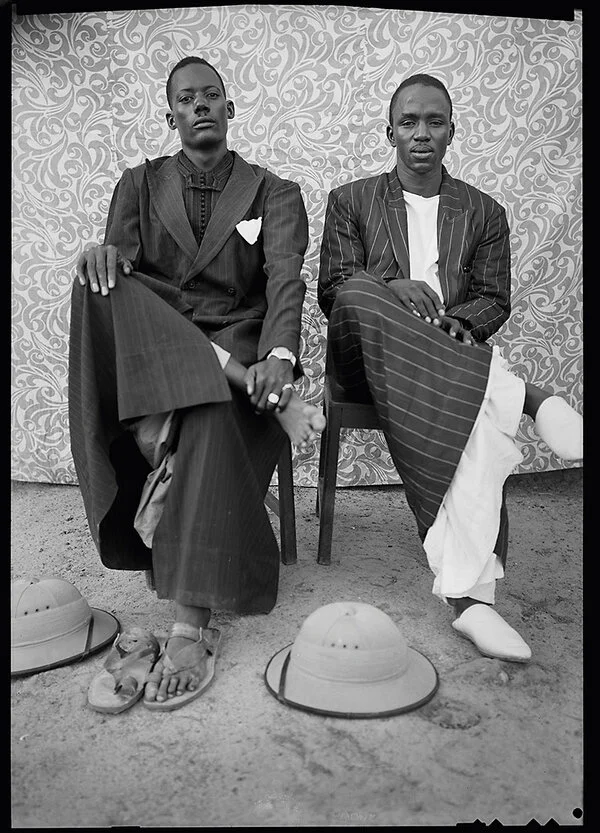
In 1948, Keïta opened a portrait studio in the courtyard of his family compound. For the next 15 years, customers arrived in steady streams to have their pictures taken, eager to fix their image for posterity. They came dressed in their finest or chose from props Keïta provided: watches, pens, radios, Western suits and ties, even a Vespa scooter.
His reputation for portraiture spread widely. "The self-image fixed on paper — it started with Seydou," as family member Kader Keïta told exhibition curator Catherine E. McKinley. Clients traveled from across West Africa to queue in Keïta's courtyard, selecting their poses and costumes from his samples while his family members offered them tea and conversation. Each session was something of a celebration — often marking a wedding, engagement, or birth.
Keïta photographed throughout the day, then retreated to his darkroom each night to produce 5-by-7 prints that sitters collected the following morning.
What makes these portraits remarkable is how much Keïta achieved under constraint. Self-taught, he clicked the shutter only once per sitting — a necessity of economy — yet his mastery of natural light (electricity being a luxury) produced images of extraordinary luminosity. Skin glistens. Fingernails catch the light.
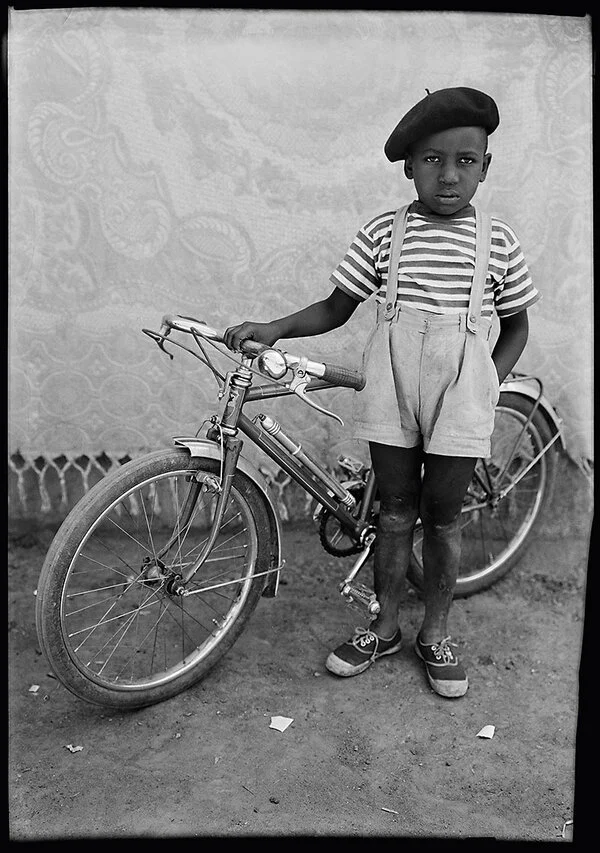
Each portrait was a collaboration between photographer and subject. Keïta smoothed garments and guided poses with care, coaxing a commanding sculptural presence from each sitter. The result is unmistakable: subjects who meet the camera's eye with dignity, authority, and unmistakable vitality — figures who seem to step forward from the frame itself.
Handwoven textiles used as backdrops are among Keïta's most recognizable signatures, evoking the richness of African visual culture. (His younger brothers were tasked with holding the fabrics aloft — including, at times, Keïta's own fringed bedspread.) These patterned backgrounds lend his images a striking dynamism, density, and layered detail. The technique would resonate across generations, reappearing in the work of contemporary artists such as Mickalene Thomas and Kehinde Wiley, whose portrait of President Barack Obama draws on a similarly saturated decorative tradition.
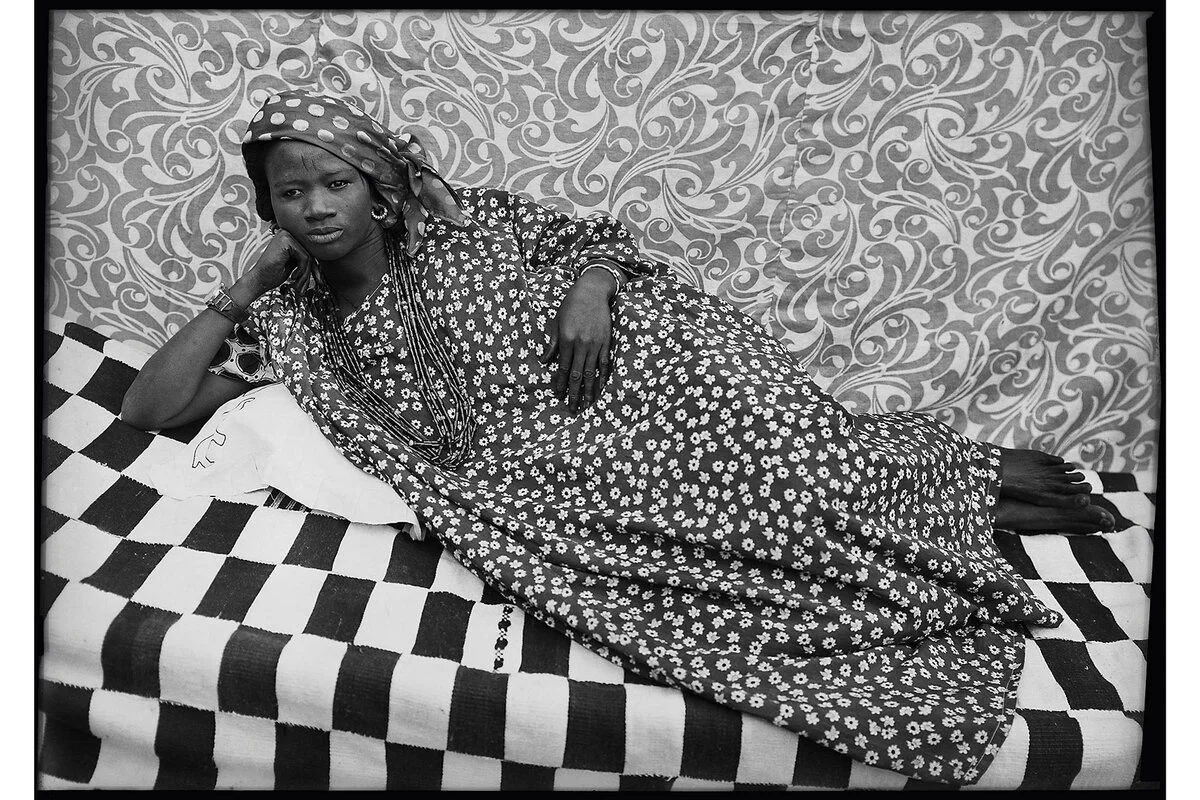
One print — depicting a woman in a recumbent pose — illustrates how deliberately Keïta composed his images. Reclining on a checkerboard fabric, the subject wears a flowered gown and polka-dotted headscarf, while arabesque patterns from the backdrop swirl around her. The effect is both sumptuous and precisely controlled, a hallmark of his approach to portraiture.
Despite his stature as a celebrated 20th-century African master, Keïta's introduction to the Western art world came almost by chance. Two of his portraits — credited anonymously — caused a sensation at a 1991 group exhibition of African art in New York. Collector Jean Pigozzi traced the images to their Malian creator, who was then working as an auto mechanic.
Keïta's studio had been forcibly closed by Malian government officials in 1963, compelling him to work for the state until he walked away in 1977. Following his rediscovery, collectors and museums reprinted his negatives using modern technology, producing large-format works that Keïta had never seen before. The experience moved him deeply. "I knew then that my work was really, really good," he said shortly before his death in 2001. "The people in my photos looked so alive, almost as if they were standing right in front of me."
Keïta's images capture both his subjects' aspirations toward a modern urban identity and their deep reverence for enduring cultural traditions. Viewed together, they form a portrait — through the lens of a masterful photographer — of a society in the midst of transformation.
The exhibition "Seydou Keïta: A Tactile Lens" is on display at the Brooklyn Museum until May 17. Nine photographs by Keïta are also on view at New York's Museum of Modern Art in a group show, "Ideas of Africa: Portraiture and Political Imagination," through July 25.