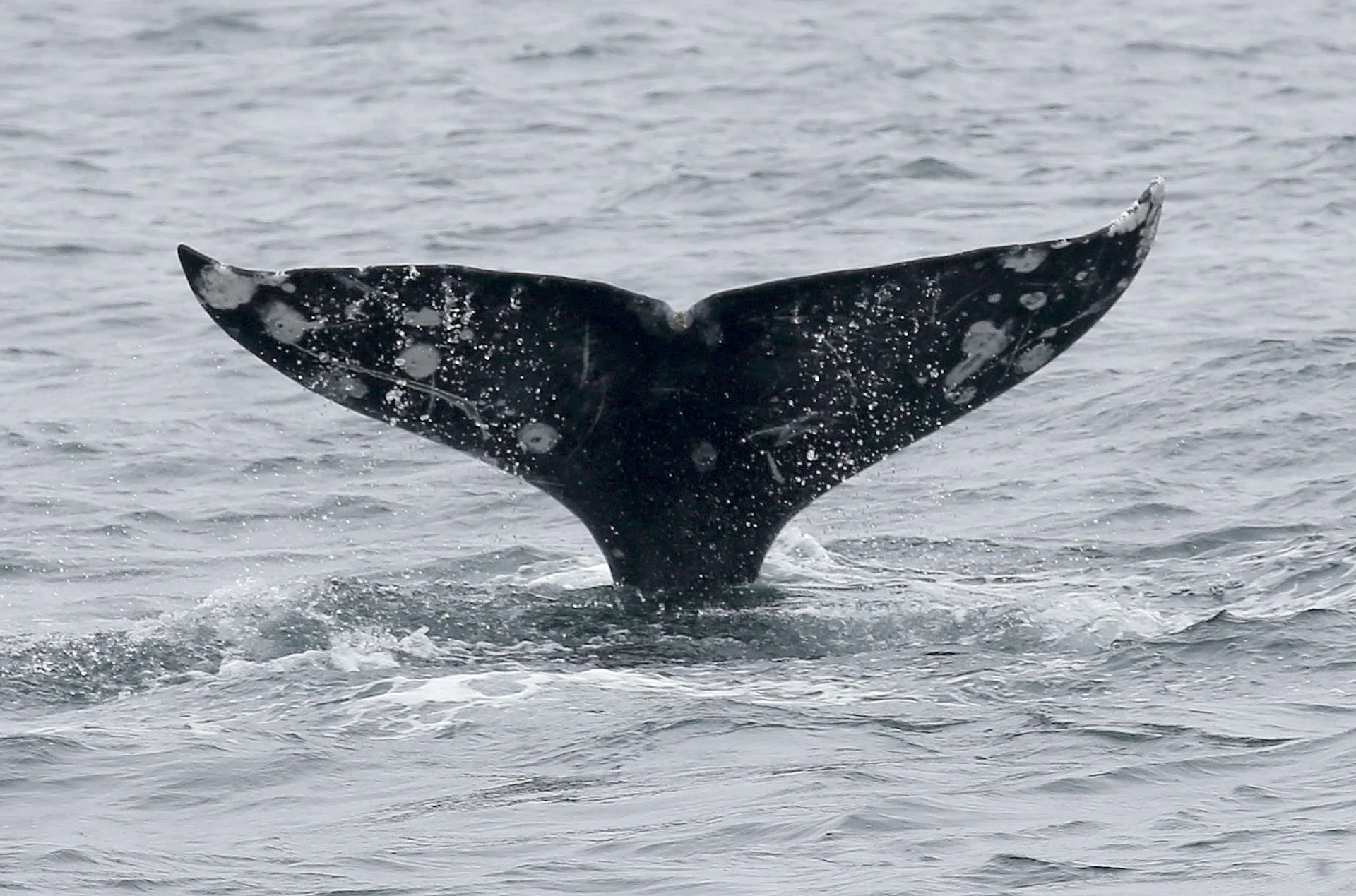
From mid-March to early April 2026, at least six gray whales have died in San Francisco Bay. The deaths continue a troubling pattern observed over recent years, and marine biologists who study the bay are warning that 2026 may be shaping up as yet another deadly year for an already imperiled population.
Most eastern North Pacific gray whales travel along California's coastline each year, moving between winter breeding grounds in Baja California, Mexico, and summer feeding grounds in the Arctic. These animals can reach 90,000 pounds and stretch over 40 feet in length. Historically, they rarely lingered in San Francisco Bay — and when they did, it tended to coincide with years when Arctic food supplies ran low.
In recent years, however, researchers have documented large numbers of gray whales taking up residence in the bay's waters, accompanied by an alarmingly high mortality rate.

What's killing the whales
San Francisco Bay is a heavily trafficked urban waterway — high-speed ferries, cargo ships, commercial fishing boats, and recreational watercraft all share its waters. For slow-moving whales, that is a potentially lethal environment.
To track gray whale activity in the bay, researchers conducted field surveys and gathered photographs from whale-watching naturalists and community observers. Gray whales carry distinctive mottling patterns and markings on their flanks and tails — some present from birth, others accumulated as scars over a lifetime — which allow scientists to identify individual animals.

Between 2018 and 2025, researchers documented 114 individual gray whales visiting San Francisco Bay for varying durations — but very few returned in subsequent years, a pattern that may itself reflect how dangerous the bay has become.
At least 18% of the whales documented alive in the bay from 2018 to 2025 were later found dead in the area. Researchers believe the true mortality rate is higher still, since many carcasses could not be recovered for examination. Of the 70 dead whales included in the study, 30 showed physical evidence of vessel strikes. Researchers also documented living whales bearing serious vessel-related injuries — wounds that can impair an animal's ability to feed and survive.

The whales aren't recovering this time
Since 2016, the eastern North Pacific gray whale population has fallen by more than half, a collapse largely attributed to declining food availability. Rising ocean temperatures and shrinking sea ice are reducing both the quantity and quality of the crustaceans gray whales sift from the seafloor in Arctic feeding grounds.
The species has bounced back before — after major die-offs in the 1990s and early 2020s, populations rebounded. But calf numbers in recent years have been extremely low, suggesting the recovery is not taking hold, a trend that has scientists deeply concerned.
Some subgroups of eastern North Pacific gray whales have adapted to forage outside the Arctic. The Pacific coast feeding group and the North Puget Sound whales, known as the Sounders, target alternative prey — including ghost shrimp in Puget Sound — farther south. In lean Arctic years, these groups may linger longer, sometimes attracting additional whales from the broader population. While some researchers initially suspected that the whales entering San Francisco Bay belonged to these subgroups, new research found that was not the case.
Vessel strikes are not confined to the bay. In April 2026, two gray whales were found dead on the Oregon coast — both malnourished, with one showing signs of a ship strike. Separately, a starving young gray whale died after traveling roughly 20 miles up Washington's Willapa River, a stark illustration of how far these animals are ranging in search of food.
What can be done to help the whales?
Management strategies have helped other large whale species facing similar pressures. Among the most effective: seasonal slow-speed zones during migration that activate when whales are present. Research shows that when vessels reduce speed to 10 knots or below, they significantly lower the risk of a fatal strike, giving whales more time to clear the path and captains more time to react.
In recent years, the National Oceanic and Atmospheric Administration has asked ships to voluntarily slow to 10 knots in Pacific waters off Monterey and San Francisco. But those limits are not mandatory and have typically not taken effect until May 1 — after the peak of gray whale presence in the bay. The Port of Oakland similarly encourages vessels to keep below 10 knots, though again only as a recommendation.
Expanded education programs for boat operators — combined with technologies such as thermal cameras to detect whales at night or in low visibility — could further reduce the risk of vessel strikes in the bay.
As climate change continues to degrade Arctic feeding grounds, nutritionally stressed gray whales may increasingly treat San Francisco Bay as a refuge. Researchers hope that their findings, combined with data gathered across the whales' migratory range, will give marine resource managers and policymakers the tools they need to better protect these animals in one of the world's busiest urban waterways.

Primary funding for the study was provided by the National Science Foundation's Graduate Research Fellowship Program, with secondary funding from California State University's Council on Ocean Affairs, Science, and Technology. Necropsy fieldwork was supported by John H. Prescott Marine Mammal Rescue Assistance Grants. Survey fieldwork was supported through funding and resources obtained by The Marine Mammal Center.
Daniel Crocker receives funding from the Office of Naval Research.