The U.S. conflict with Iran has not remained solely in the realm of geopolitics. Religious language has increasingly been deployed to frame strategic military objectives as matters of sacred duty or divine judgment.
On March 4, 2026, House Speaker Mike Johnson characterized Shiite Islam — the majority faith tradition of Iran — as a "misguided religion" while publicly discussing ongoing U.S. strikes. That same month, a complaint filed with the Military Religious Freedom Foundation alleged that an unnamed military commander had declared that "President Trump has been anointed by Jesus to light the signal fire in Iran to cause Armageddon and mark his return to Earth" — an explicit invocation of the Book of Revelation's depiction of a final, apocalyptic battle between good and evil preceding the second coming of Jesus Christ.
Shortly after U.S. forces struck Iran, right-wing pastor Andrew Sedra argued that "Trump is going after the head of the snake, which is Islam," adding that "God is using President Trump in a prophetic moment of time to execute judgment on evil and wicked civilizations."
This kind of religious framing does not emerge from a vacuum. It draws on centuries-old Christian narratives portraying Islam as a violent and extreme faith. Over recent decades, a notable number of American politicians and Christian clergy have repeated and amplified these characterizations. Research into this history reveals that today's rhetoric is deeply continuous with those earlier traditions.
Hostile depictions
Christian theologians began positioning Islam as a theological rival almost from the religion's emergence in 610 C.E. In the eighth century, the monk John of Damascus wrote what is widely regarded as the earliest documented Christian critique of Islamic doctrine, categorizing Islam as a "heresy" in his treatise "The 'Heresy of the Ishmaelites.'"
In his 2002 book "Saracens: Islam in the Medieval European Imagination," historian John Tolan documents how medieval Christian writers spread "crude insults to the Prophet, gross caricatures of Muslim ritual [and] deliberate deformation of passages of the Koran," portraying Muslims as "libidinous, gluttonous semi-human barbarians."
Tolan and other historians trace how these hostile images took shape across monasteries and royal courts, eventually filtering into popular culture through epic poems — the chansons de geste — that glorified Christian warriors defeating Muslim adversaries.
It is worth noting that medieval Muslim theologians produced equally pointed critiques of Christian doctrines such as the Trinity, which they considered polytheistic. However, those writings remained largely within scholarly circles. In Christian Europe, anti-Muslim rhetoric served a far more public and political function: it was used to justify the Crusades. In 1095, Pope Urban II called on Christians to wrest the Holy Land from those who lived there and restore it to Christian dominion.

The Second, Third, and Fourth Crusades were similarly preceded by papal letters casting Muslims as enemies of the faith and urging Christians to reclaim Palestine.
When the Crusades ultimately failed militarily, they created a fresh theological dilemma. Medieval Christians understood history as a reflection of divine will, which made it difficult to explain the military success of Muslim armies without implying that God favored Islam. One widely adopted resolution was to interpret Christian defeats as punishment for Christian sin — a framework that preserved theological coherence while deepening the demonization of Muslim opponents.
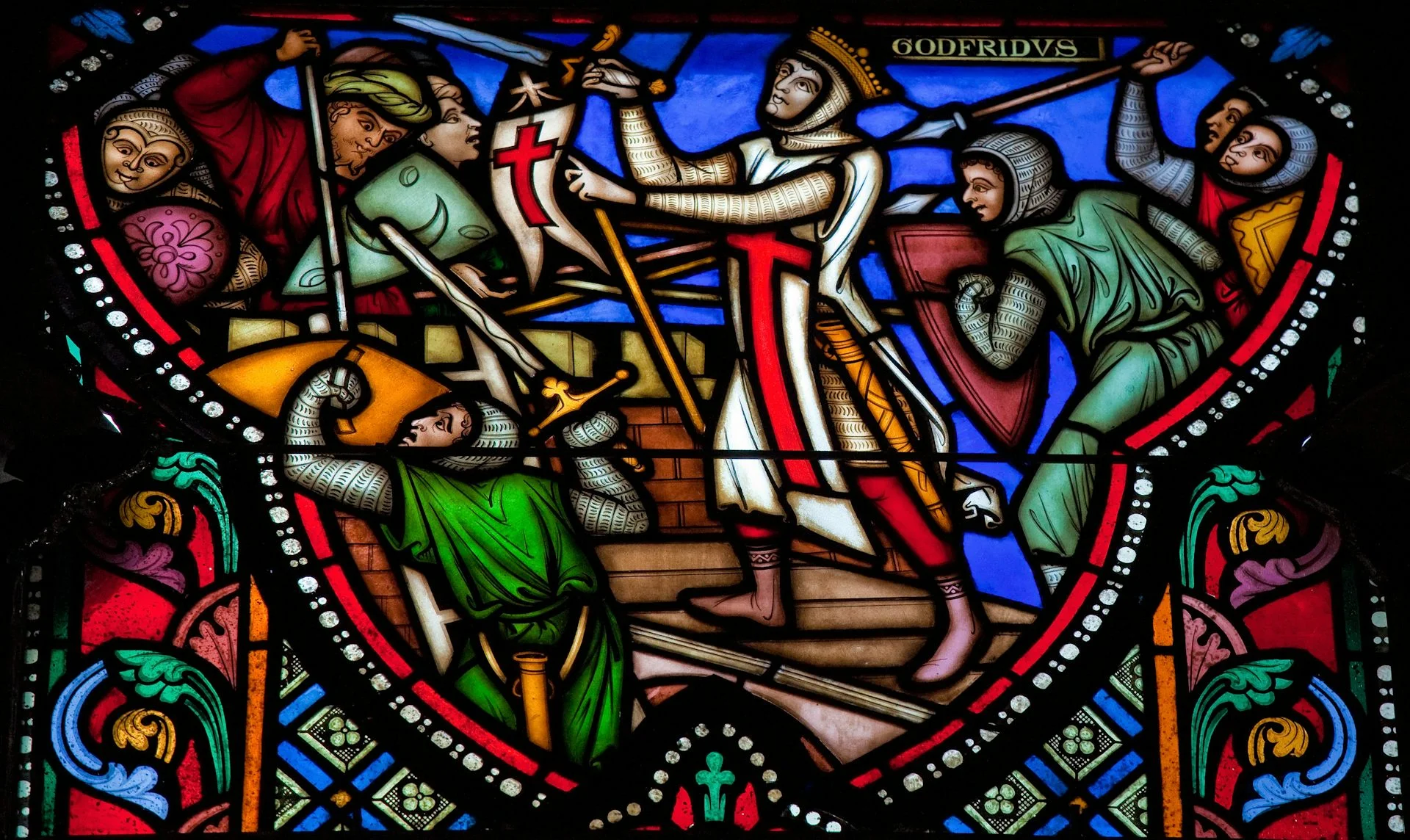
Medieval epic poems and visual art reflected this shift, frequently depicting Muslims as near-demonic, bloodthirsty figures — turbaned and robed as visual shorthand for menace and otherness.
Christian missionary narratives
In later centuries, anti-Muslim depictions were repurposed to provide moral cover for colonialism. Scholar Edward Said examined this transformation in his landmark 1978 work, "Orientalism," arguing that Western narratives systematically reduced the peoples of the Middle East and Arab world to a cluster of negative stereotypes: barbaric, violent, and incomprehensible, yet also lazy, gullible, and exotic. Though not universally held, these ideas circulated widely within Western Christian intellectual traditions, shaping durable representations of Muslims in literature, art, theology, and politics.
Scholar Deepa Kumar observed that while ordinary people can resist dominant narratives, "those who rule the society tend to set the terms of discussion" — a dynamic that helps explain how prejudicial ideas persist even when challenged from below.
These anti-Muslim tropes found a natural home in Christian missionary discourse. In the 19th century, figures such as David Livingstone championed what became known as the "three C's" — Christianity, commerce, and civilization — framing European colonial expansion as an act of benevolence toward colonized peoples. Islam was frequently cast as the antithesis of this civilizing mission: missionaries contrasted Christianity's supposed moral authority with a portrayal of Islam as stagnant, simplistic, and backward.
Islamophobia today
These hostile themes have been reworked across centuries, but they remain recognizable in contemporary political and media rhetoric — and their effects on public understanding of Islam are significant.

A survey of American Baptist clergy conducted for the 2026 book "Confronting Islamophobia in the Church," co-authored with Baptist pastor Michael Woolf, found that many pastors describe Islam and Muslims as inherently violent, blasphemous, oppressive toward women, or fundamentally incompatible with Western society. The theological vocabulary has modernized — accusations of Islamic "heresy" have given way to concerns about violence and women's rights — but the underlying framework is recognizably old.
A 2019 study found that nine in ten pastors believe they shape what their congregants think about social issues, a finding that underscores how religious prejudice, including Islamophobia, can be systematically reinforced in church settings. Historian Kristin Kobes Du Mez, a leading scholar of American evangelicalism, notes that Islam has long been portrayed in evangelical contexts as violent and antithetical to Christian values. In her 2020 bestseller "Jesus and John Wayne," she cites a 2002 poll showing that 77% of evangelical leaders held an unfavorable view of Islam overall, and 70% agreed that it was "a religion of violence."
Pushback does exist. Organizations such as the Council on American-Islamic Relations and interfaith coalitions like the Shoulder to Shoulder Campaign have partnered with Christian communities to challenge these portrayals. The Shoulder to Shoulder Campaign, for instance, runs a national anti-Islamophobia training program for pastors and congregations called Faith over Fear.
The stakes are concrete. Researchers have linked inflammatory rhetoric about Muslims to measurable spikes in discrimination and hate crimes across Europe and North America. A study by the Center for the Study of Organized Hate documented a significant surge in anti-Muslim hate speech in the first week of the war with Iran. When political leaders frame Islam as the enemy and cast the West in the role of civilizing force, the consequences are not confined to distant battlefields — they manifest as everyday hostility directed at Muslim communities across the United States.

Anna Piela previously received funding from the National Science Center in Poland, the American Academy of Religion, and the Interfaith Alliance. Currently she is not receiving any funding.



_(crop).png)