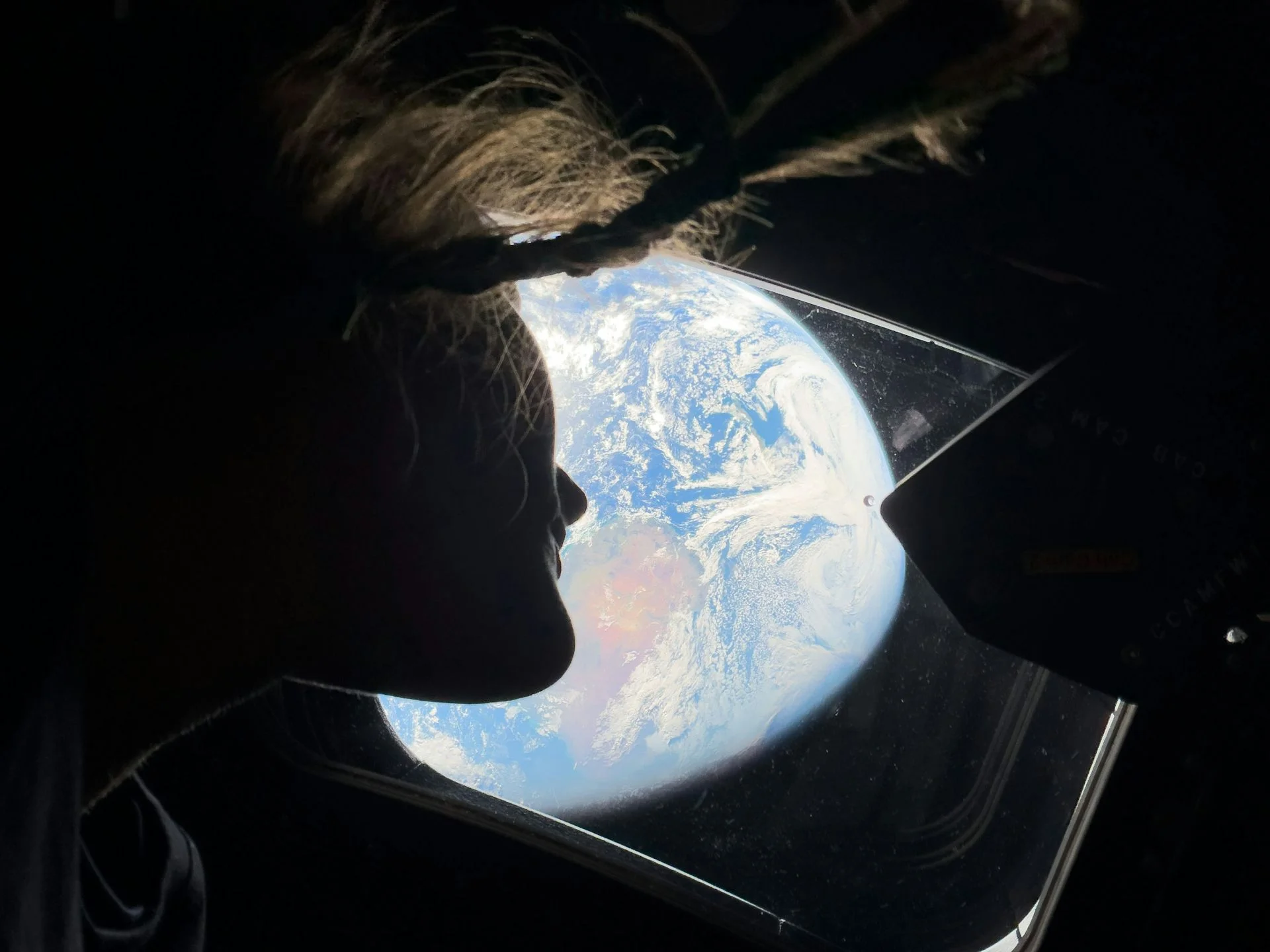
NASA's archive of human spaceflight is rich — documents, artifacts, and images that together tell the story of every mission since the dawn of the Space Age. But with the Artemis II lunar mission now complete, we're seeing that story written anew. The photographs beamed back to Earth — some transmitted mid-mission — offer a vivid, contemporary portrait of what it means to travel beyond our planet.
For entire generations born after Apollo 17's final lunar close-ups in 1972, the reality of Artemis II may take some absorbing — particularly in an era saturated with AI-generated imagery and digital manipulation. But the mission was real. Four humans circled the Moon, and the photographs now safely stored on memory cards in NASA's custody are their testament.
As a space historian and curator who has spent years studying the visual culture of human spaceflight, I've long waited for images like these — a return to the Moon rendered in the full fidelity of modern photography.
Post-Apollo, our mental image of space exploration was shaped by shuttle launches, modular space stations, and rovers inching across Martian dust. The Artemis II images carry the same timeless grandeur as Apollo's finest frames, but with a crispness and clarity that modern photographic tools uniquely enable. Space travel, in these photographs, finally looks the way many people have always imagined it should: vast, daring, and awe-inspiring.
As a member of Gen X, I have no firsthand memory of Apollo. My generation's relationship with space was forged through other images — the devastating Challenger launch; John Glenn returning to orbit at 77; the otherworldly deep-field vistas from the Hubble Space Telescope. Powerful as those were, none of them placed humans near the Moon. Many people of my generation have quietly been waiting for lunar memories to call their own, a shared experience to hold in common.
The internet and social media have transformed the speed and scale at which imagery travels, and the Artemis II photographs became almost instantly iconic as a result. They also invited immediate comparison — slotting into a collective visual memory of exploration photography that predates spaceflight itself.

Planning and taking photos
Crew members Reid Wiseman, Victor Glover, Christina Koch, and Jeremy Hansen completed weeks of photography training using an array of Nikon digital cameras and iPhones. The leap from the 35mm film cameras of the Apollo era to the equipment available today is staggering — particularly the inclusion of a device most people carry in their pocket.
NASA's longstanding preference for the Nikon D5, relied upon aboard the International Space Station for its proven reliability, carried over to Artemis II. When astronauts are in space, NASA prizes dependability above all else.
Beyond the cameras themselves, the Artemis program approached lunar photography differently than Apollo from the start. The Orion spacecraft is larger than Apollo's command module and features twice as many windows and interior cameras. Five of Orion's six windows were equipped with live-streaming video cameras during the lunar flyby.
The mission's wide arc around the Moon — farther out than any Apollo trajectory — also meant the crew had broader sightlines, taking in more of the lunar surface in a single glance than any astronaut before them.
The crew trained alongside geologists and other scientists to identify prospective landing sites, craters, and scientifically significant surface features. Audiences watching online could hear the astronauts narrate what they saw in real time, with dialogue between the Orion capsule and the Artemis Science Team broadcast live.
Remarkable new images
Mission planners knew from the launch date and lunar positioning that the crew would have a shot at extraordinary compositions — including an Earthset and a solar eclipse — and they prepared accordingly.

Earthrise entered the cultural lexicon through Apollo 8. That particular angle wasn't available to Artemis II — the Moon's phase left that region in darkness — so a direct comparison with the 1968 image wasn't possible. But another visual echo with Apollo emerged early in the mission, and it may prove even more resonant.
In 1972, roughly five hours after Apollo 17 departed for the Moon, geologist Harrison Schmitt photographed Earth as a fully illuminated disc hanging in the black of space. That image became one of the defining photographs of the Space Age — and arguably of the entire 20th century, later featured in Al Gore's documentary An Inconvenient Truth.

Earth 1972. Earth 2026. Both are documents of singular moments in our planet's long history. The new photograph shows Earth — this time lit by lunar rather than solar light — suspended in deep space, its paper-thin atmosphere just visible at the edge, shimmering with polar aurorae.
Schmitt's "Blue Marble" spent more than five decades among the most reproduced photographs ever taken. Its Artemis successor reached audiences within hours of capture — yet it may struggle for the same enduring recognition in a media environment increasingly clouded by synthetic imagery and digital manipulation.
Even so, these early frames are only a preview. Modern memory cards will allow the Artemis II image archive to vastly exceed the nearly 4,000 photographs taken during Apollo 17. As that archive fills online databases in the weeks and months ahead, Artemis II's place as a new chapter in the visual history of human space exploration will only deepen — building on Apollo's legacy while beginning one entirely its own.

Jennifer Levasseur does not work for, consult, own shares in or receive funding from any company or organization that would benefit from this article, and has disclosed no relevant affiliations beyond their academic appointment.