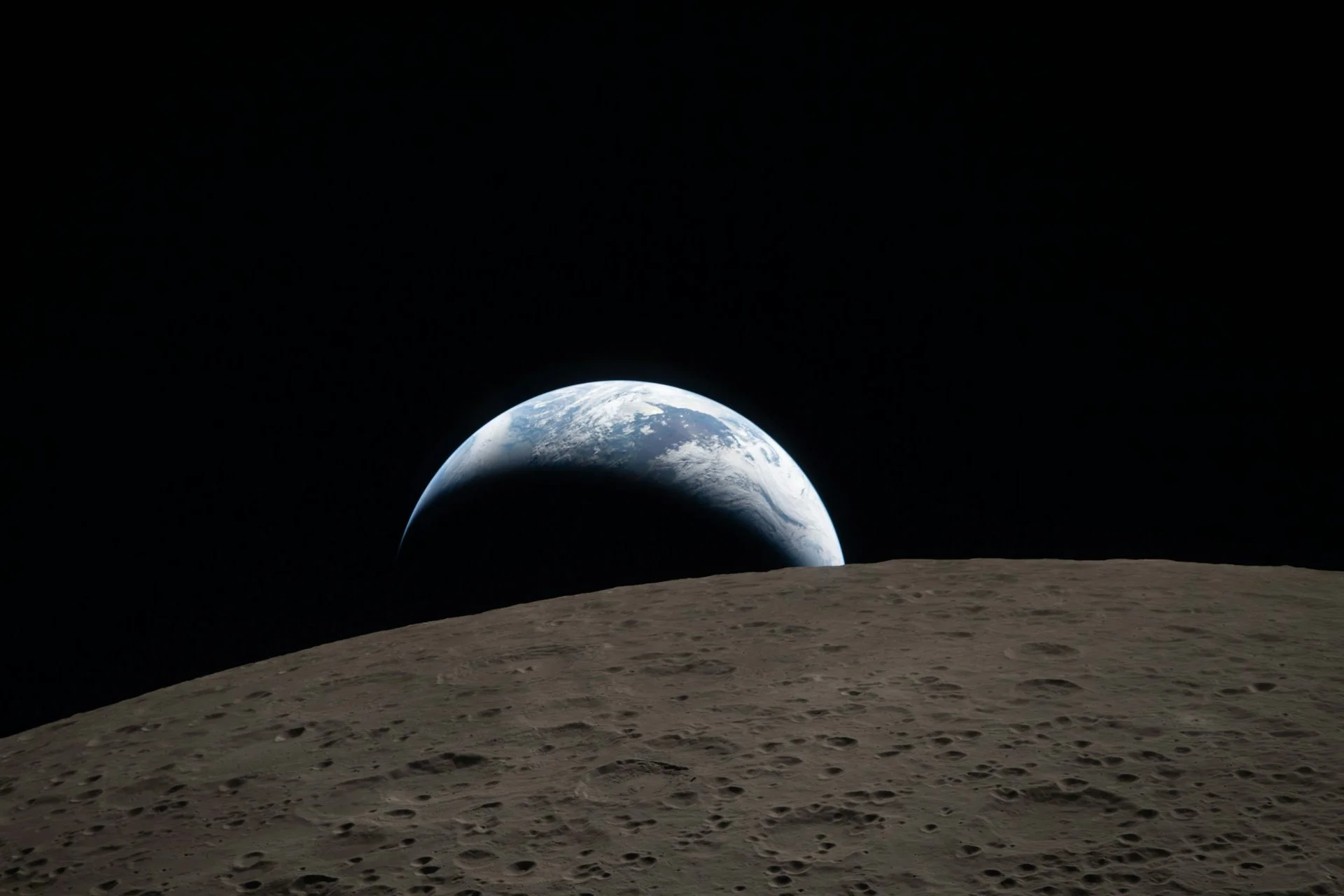
When NASA's Artemis II mission launched on April 1, 2026, it marked humanity's return to the Moon for the first time in half a century — since the era of Apollo.
When Apollo 11 first touched the lunar surface, the astronauts framed their achievement as the fulfillment of a science-fictional dream. During a televised broadcast on the return journey, Neil Armstrong explicitly invoked Jules Verne's 1865 novel "From the Earth to the Moon," describing his spacecraft and crew as a "modern-day Columbia" — a direct nod to the fictional vessel Verne imagined departing from Florida and splashing down in the Pacific.
Conversations about science fiction becoming reality tend to fixate on the technologies it anticipated. But as sci-fi author Frederik Pohl reputedly observed, the real insight isn't imagining the car — it's imagining the traffic jam.
As a literature professor who has spent a decade studying science fiction and as the editor of a forthcoming annotated edition of Verne's novel prepared for the spacefaring age, I find that what makes Verne's book genuinely prescient isn't its technical imagination. It's that a full century before the Moon landing, Verne grasped that a moonshot would never be an act of pure, abstract science. It would unfold within a political, social, and economic context — shaped by all the forces those words imply.

In the novel, the moonshot is proposed by the Baltimore Gun Club in the uneasy months following the U.S. Civil War. Verne traces how this colossal undertaking actually gets made — the financing, the politics, the public spectacle. Writing before the age of powered flight, he foresaw that sending even a small group of exceptional individuals beyond Earth would send ripples across the entire world.
Now, with four astronauts having just completed a lunar flyby as part of Artemis II, the parallels between Verne's vision and America's current lunar ambitions are both striking and revealing about the realities of the spacefaring age.

A nationalist and international project
In Verne's novel, the moonshot is explicitly framed as a nationalist endeavor — even as it simultaneously becomes a pinnacle of human achievement that unites the world. The speech proposing the mission brims with celebration of American engineers, scientists, and generals, and Americanness is treated as central to the entire enterprise.
At one point, it becomes clear the launch must occur near the equator to minimize distance to the Moon. But since this is, above all, an American project, the protagonists insist it must depart from U.S. soil. The Gun Club briefly entertains the idea of invading Mexico before remembering that Florida and Texas both lie close enough to the equator.

When a Frenchman, Michel Ardan, telegraphs his wish to join the voyage, he is welcomed and celebrated — but only permitted to board after being made an honorary U.S. citizen.
And yet the moonshot transcends its national origins. Every person on Earth tracks the news via telegraph, and the project draws widespread global support on the grounds that "it was both the right and the duty of the entire Earth to intervene in the affairs of its satellite." Nations pool resources and hold their breath as launch day approaches.
The parallels to the space race are hard to miss. In the 1960s, the Moon became another front in the Cold War — a high-stakes ideological contest over which system, communism or liberal democracy, could put a human being there first. Yet the Apollo landings have always been celebrated, too, as a triumph of human ingenuity and will that belongs to everyone.
Artemis II is animated by the same tension between nationalism and universal aspiration. In the moments before launch, Canadian astronaut Jeremy Hansen told NASA and the watching world, "We are going for all humanity." The inclusion of a Canadian astronaut alongside an American crew also marks a genuine departure from Cold War precedent.
Throughout the mission, the crew and NASA's ground controllers repeatedly reached for language of shared humanity. After the translunar injection burn that committed Orion to its lunar trajectory, astronaut Christina Koch declared, "We will always choose Earth. We will always choose each other" — to which Mission Control responded: "Integrity from Earth, our single system, fragile and interconnected, we copy. Those that can are looking back."
And yet Artemis II is also a significant milestone in a new-era space race, this time between the United States and China. The Artemis program is explicitly designed to return Americans to the Moon before China does. NASA Administrator Jared Isaacman has made no secret of it: getting there first, he has argued, is essential to demonstrating American excellence on the world stage and preserving U.S. economic influence and soft power.
Planetary colonization
In Verne's novel, the original motivation for the moonshot is articulated by the character Barbicane: they aim to become "the Columbuses of this new world." Though the mission is framed as a scientific experiment, the characters fundamentally view the Moon as territory to be claimed — destined, eventually, to become the newest American state.
This worldview treats the natural world and the cosmos as frontiers to be conquered, echoing the imperial and colonial logic of Verne's era — the assumption that places like Africa or the American West were blank slates awaiting claim, regardless of who already inhabited them.
Visions like Verne's shaped the thinking of many engineers and scientists who made human spaceflight possible, including Robert Goddard and Konstantin Tsiolkovsky, both of whom believed that humanity's destiny lies among the stars.
That same framework has surfaced in the rhetoric around Artemis II. While the mission carries extensive scientific objectives — including, for the first time, a dedicated science desk at Mission Control — NASA has also consistently celebrated the mission as historic because it carried human beings farther from Earth than anyone has ever traveled. If space is "the final frontier," to borrow "Star Trek"'s enduring phrase, then Artemis II is historic precisely because it pushed American astronauts deeper into that frontier.
Environmental effects
In Verne's novel, Tampa, Florida is chosen as "Moon City" — the launch site for the moonbound projectile. The designation becomes a profound economic windfall for the city, foreshadowing how real communities in Florida, Texas, and beyond experienced dramatic economic and population growth in the 20th century fueled by the Apollo program.
Yet the moonshot carries a darker undercurrent in Verne's novel: the sheer force of the detonation that launches the three explorers toward the Moon levels the surrounding city, unleashing a powerful shockwave that rolls into the Atlantic Ocean and sends ships to the bottom of the sea.
Today's space industry offers comparable economic rewards — companies such as SpaceX and Blue Origin employ thousands and have revitalized entire regional economies. But the costs, as in Verne's fiction, are rarely distributed equally.

SpaceX's Starbase complex in South Texas — the primary development and launch site for its Starship vehicle, which is slated to carry NASA astronauts to the Moon — has left a troubling mark on the surrounding landscape and communities. Failed test launches have scattered shrapnel and debris across the area, putting residents at risk and threatening fragile local ecosystems. Persistent noise, water, and air pollution have proven both a quality-of-life burden for neighbors and a serious threat to endangered species in the region.
The enduring power of a work like Verne's lies not in the accuracy of its imagined technologies, but in its insistence on reckoning with their consequences — a discipline that remains just as urgent today.
This article was updated with the correct original cover image of "From the Earth to the Moon."

Anastasia Klimchynskaya does not work for, consult, own shares in or receive funding from any company or organization that would benefit from this article, and has disclosed no relevant affiliations beyond their academic appointment.



.jpg)